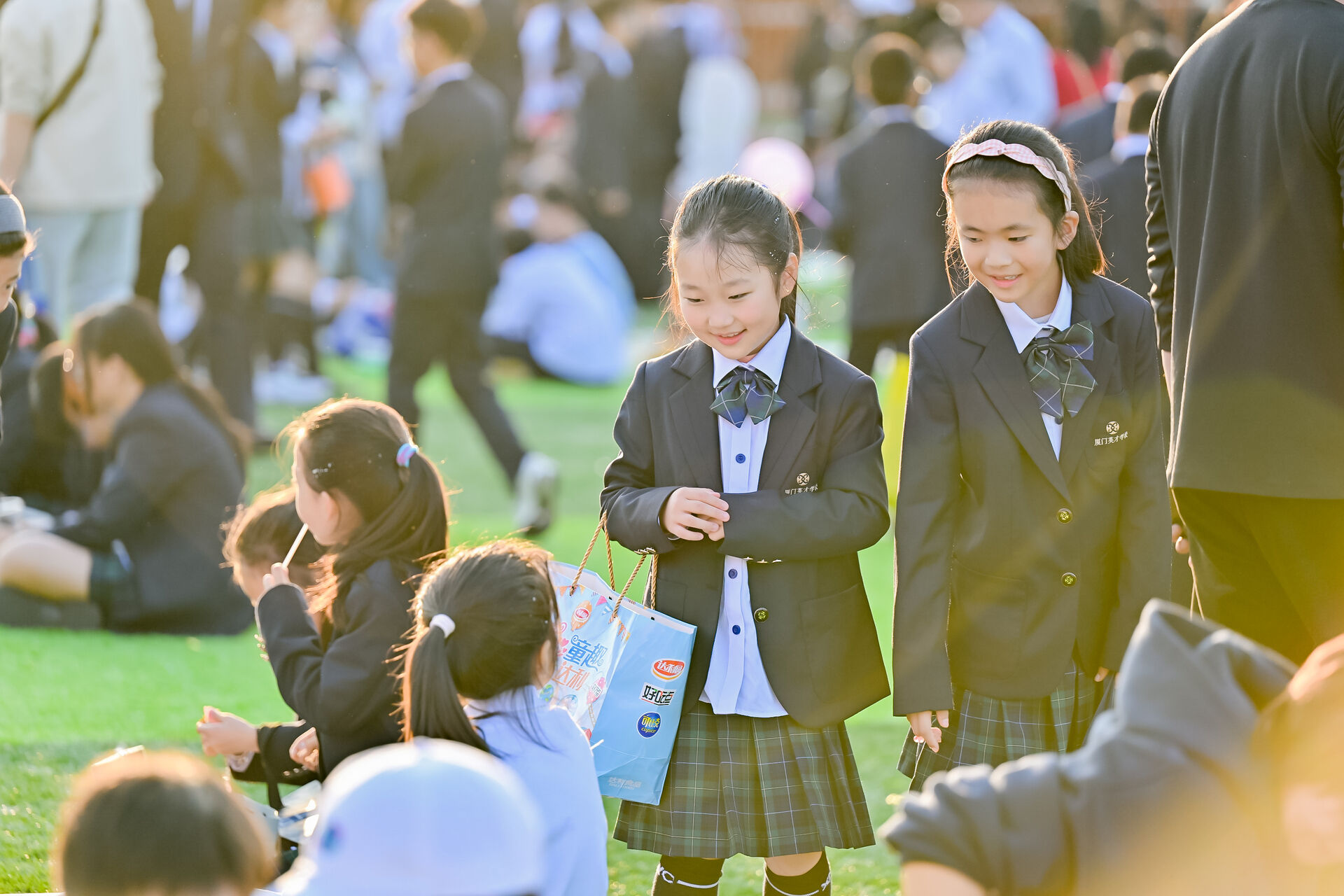

1. Long-established experience: With 30 years of experience in early childhood education, the kindergarten was the first privately run provincial model kindergarten in Xiamen. Its curriculum is developed and implemented with reference to key stages of child development and developmental psychology, providing a mature and professional educational system.
2. Natural campus environment: The kindergarten is located within a spacious 250-mu campus, offering a green, nature-rich environment with seasonal scenery. Learning and living spaces are designed from a child's perspective, with rounded, padded edges and environmentally responsible, child-safe materials.
3. Specialist facilities: The kindergarten includes a science and innovation room, creative art room, Orff music room, picture-book reading area, English-themed learning corners and a sensory integration training area. As part of a 15-year integrated school, children can also share high-quality facilities such as playgrounds, sports venues and specialist activity spaces.
4. Boarding care: The kindergarten provides detailed full-boarding care, with residential life teachers available around the clock. Evening calming activities and scheduled overnight checks support children's emotional wellbeing while helping them develop independence and self-care skills.
5. Kindergarten–primary transition: Through the school's integrated kindergarten-to-senior-secondary structure, primary teachers visit the kindergarten each week to deliver activities and take part in joint teaching research. Learning routines, habits and classroom expectations are gradually aligned to support a smooth transition into primary school.
6. Favourable teacher–child ratios: The overall teacher–child ratio is 1:4, and 1:3 in the toddler classes. These ratios allow staff to provide close support for children's emotions, daily habits and individual development.
The kindergarten combines bilingual immersion with Project-Based Learning (PBL) to create a whole-child curriculum integrating science, humanities and character development. It covers science and innovation, physical development, the arts and nature exploration, helping children encounter a diverse world and develop an international outlook.
1. Curriculum structure
• Foundation: An all-day bilingual immersion environment.
• Core: Thematic inquiry and PBL integrating science and innovation, the arts, physical development—including daily outdoor activity, sensory integration training and nature walks—and nature exploration.
• Extension: Specialist clubs, educational visits, themed festivals and community-based experiences.
2. Age-appropriate development
• Toddler stage (1.5–3 years): Building secure attachment and sensory awareness. Caring support, music and movement, sensory play and daily-life experiences help children develop security, perception and basic self-care skills.
• Ages 3–5: Cross-disciplinary inquiry and active learning. Nature and everyday life become learning contexts for regular PBL projects that develop observation, thinking, practical skills, peer collaboration and language.
• Ages 5–6: Character development and preparation for primary school. The focus is on social-emotional skills, behaviour, learning habits, cognitive foundations and broader readiness for a smooth transition to primary education.
3. Signature activities
The kindergarten offers activities such as an English Drama Festival, Treehouse Concerts, outdoor educational visits and an Academic Open Week. Through performance, artistic presentation, nature exploration and sharing their work, children develop confidence, communication, inquiry and broader capabilities.
4. Bilingual teaching and staged outcomes
English is integrated naturally into daily routines, games, picture-book reading, songs, rhymes and situational dialogue, allowing children to acquire the language without relying on rote memorisation.
• Younger class: Children adapt to an English-rich classroom, understand common instructions and begin to speak with confidence.
• Middle class: Vocabulary expands steadily, and children use familiar words and short sentences in daily interaction.
• Senior class: Children develop stronger language awareness and more fluent expression, receive an introduction to phonics, and build interest in reading English picture books independently.
5. Balanced bilingual development
Chinese is used to guide areas such as manners, traditional culture, emotional support and safety rules, ensuring balanced language development, strong cultural foundations and parallel growth in different abilities.
1. Our kindergarten offers two well-structured daily programmes – day attendance and boarding – both integrating care and education, balancing activity and rest:
Day pupils (arrive at 08:00, flexible departure between 18:00 and 20:00):
The day includes a morning health check upon arrival, bilingual immersion, PBL project‑based inquiry, arts enrichment clubs, meals and a nap, with at least 2 hours of outdoor activity daily. After dinner, children depart in an orderly manner.
Boarding pupils (wake up at 06:40, lights out at 20:30):
The day includes morning organisation and exercise, a full day of curriculum, meals and a nap, with at least 3 hours of outdoor activity daily. After dinner, children engage in post‑meal games and accompanied reading, fostering good daily routines and self‑care abilities.
2. An authentic English context is created every day. Children are naturally immersed in English through daily routines, play, activities, and real‑life scenarios. Using nursery rhymes, picture books, and interactive dialogue, we develop their language sense and oral expression.
3. Leveraging our 250‑mu campus’s rich ecological resources, we deeply integrate nature education with the 24 solar terms. Each classroom has a planting corner, and the kindergarten features a nature exploration area, a small animal raising area, and an ecological trail. Regular activities include plant observation, nature‑based creative work, weather recording, and outdoor exploration. We treat life as a textbook and nature as a classroom, enabling children to connect with nature and develop a joy for inquiry.
Drawing on the advantages of an integrated kindergarten and primary school system, the school has developed a two-way transition curriculum. Primary school teachers visit the kindergarten each week to deliver lessons, and the two teaching teams conduct joint curriculum planning and research.
After completing the transition programme, children are expected to develop the following abilities:
Bilingual communication: They can communicate confidently in both Chinese and English, understand common instructions from international teachers, speak with natural pronunciation and intonation, and have a foundation in phonics and English picture-book reading.
Academic foundations: They have basic Chinese character recognition and reading skills and can read short sentences, children's rhymes and picture books independently. They use an appropriate pencil grip and sitting posture, have developed pencil control and pre-writing skills, and understand basic mathematical concepts and ways of thinking.
Learning and social readiness: Their attention span, classroom behaviour and learning habits are broadly aligned with primary school expectations. They understand rules, adapt to social settings and can integrate into primary school group life more quickly.
Independent self-care: They can manage daily routines more independently, including washing, bathing, organising personal belongings and clothing, and packing their school bag. They begin primary school with stronger habits of tidiness and self-management.
Our kindergarten has a stable and mature teaching team, established on a four‑dimensional teacher quality standard:
1. Classroom teachers: All hold a bachelor’s degree or higher, and 100% are licensed and certified for their positions. Foreign teachers hold TESOL professional qualifications.
2. Nursery carers (childcare staff): Professional, gentle, caring, and extraordinarily patient. They provide attentive 24‑hour care, looking after daily routines with the same meticulous attention as a mother, and offer warm, dedicated support to boarding children every single day.
3. Staffing and teacher–child ratio: The teaching team has an average long service record and shares a unified educational philosophy. Each class is standardly equipped with a foreign teacher, a lead Chinese teacher, a teaching assistant, and a life teacher. Relying on the golden ratios of 1:3 (for toddler classes) and 1:4 (for other age groups), we achieve refined, individualised care.
4. Professional development system: The kindergarten has established a dual‑track professional growth system, with no less than 130 hours of annual professional training per staff member. Training focuses deeply on children’s critical developmental periods, curriculum teaching and research, safety and childcare, teacher ethics and professionalism, and other key areas, continuously evolving our educational philosophy and teaching competencies.
Our kindergarten conducts ongoing training in professional ethics, child communication skills, and teacher emotional management. We also provide faculty and staff with access to professional psychological counseling and stress support resources.
We have established a robust system for daily supervision, ethics evaluations, and oversight mechanisms to guide teachers in practicing patience, attentiveness, and compassion. Our educators are encouraged to respect each child’s natural disposition, validate their emotions, and prioritize positive reinforcement and gentle guidance over harsh discipline.
All faculty and staff are certified in pediatric first aid through specialized training and regular refresher courses. Combining professional competence with genuine educational dedication, our team remains calm, stable, and nurturing—providing consistent, high-quality companionship for every child’s growth journey.

Xinyingcai Education Group